
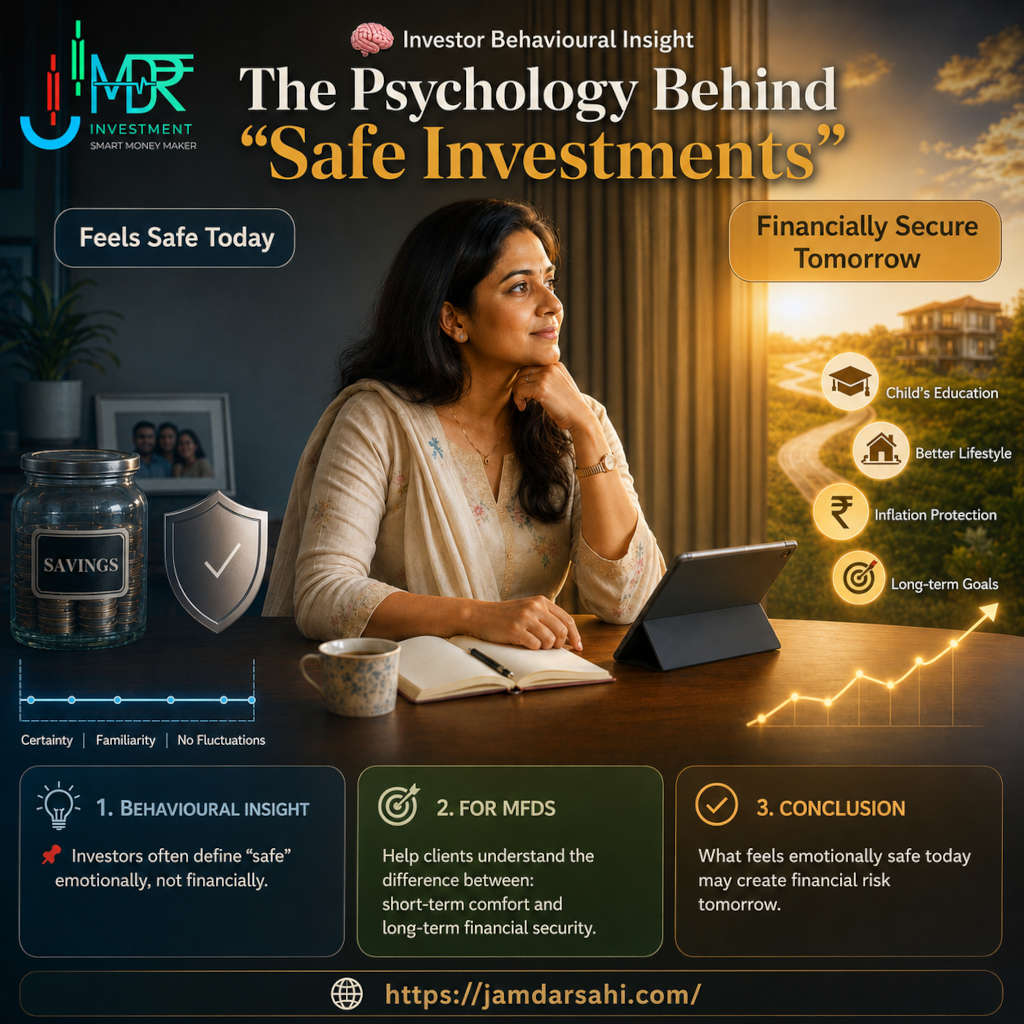
Neha, a 38-year-old school teacher and mother of one, had kept most of her savings in fixed deposits for years.
Whenever someone spoke about mutual funds or equity investing, she would immediately respond:
“I’m okay with lower returns. I just want safety.”
To her, “safe” meant:
-
No market fluctuations
-
No uncertainty
-
No fear of loss
Emotionally, that felt comfortable and reassuring.
But one day, during a financial discussion, her financial guide asked her a simple yet powerful question:
“Neha, what feels safer to you — temporary market fluctuations, or not achieving your long-term financial needs?”
She paused.
No one had ever explained investing to her from that perspective before.
Redefining the Meaning of Safety
Her financial guide continued:
“Safety is not just about avoiding volatility.
It is also about:
-
Funding future education
-
Maintaining lifestyle
-
Beating inflation
-
Protecting long-term purchasing power”
That conversation changed the way Neha looked at investing.
She slowly realised that what feels emotionally safe in the short term may sometimes create financial risk in the long term.
Understanding the Real Risk
Many investors associate risk only with market volatility.
But risk can also mean:
-
Falling short of future financial needs
-
Losing purchasing power due to inflation
-
Depending only on low-growth investments
-
Not creating enough wealth for long-term security
In reality, avoiding all fluctuations may also come with its own hidden risks.
The Role of a Financial Guide
Neha’s financial guide did not recommend aggressive investing or unnecessary risk.
Instead, he explained that different investments serve different purposes.
Some investments provide stability.
Some help create long-term growth.
Some help protect against inflation.
The key is not choosing extremes, but creating balance.
He showed her how a structured asset allocation could help her feel emotionally comfortable while still moving steadily toward her long-term financial needs.
A Shift in Mindset
After that discussion, Neha stopped asking:
“Which investment feels safest today?”
And started asking:
“What strategy helps me remain financially secure in the future?”
That small shift completely changed her relationship with investing.
Behavioural Insight
Investors often define “safe” emotionally rather than financially.
Human psychology naturally prefers:
-
Certainty
-
Familiarity
-
Stability
Even when those choices may not support long-term financial growth.
True financial distribution is not just about avoiding short-term discomfort.
It is about balancing emotional comfort with long-term financial needs.
Bottom Line
Temporary market fluctuations are visible and emotional.
But the bigger long-term risk may be not achieving important financial needs.
Because successful investing is not simply about feeling safe today…
It is about staying financially secure tomorrow.